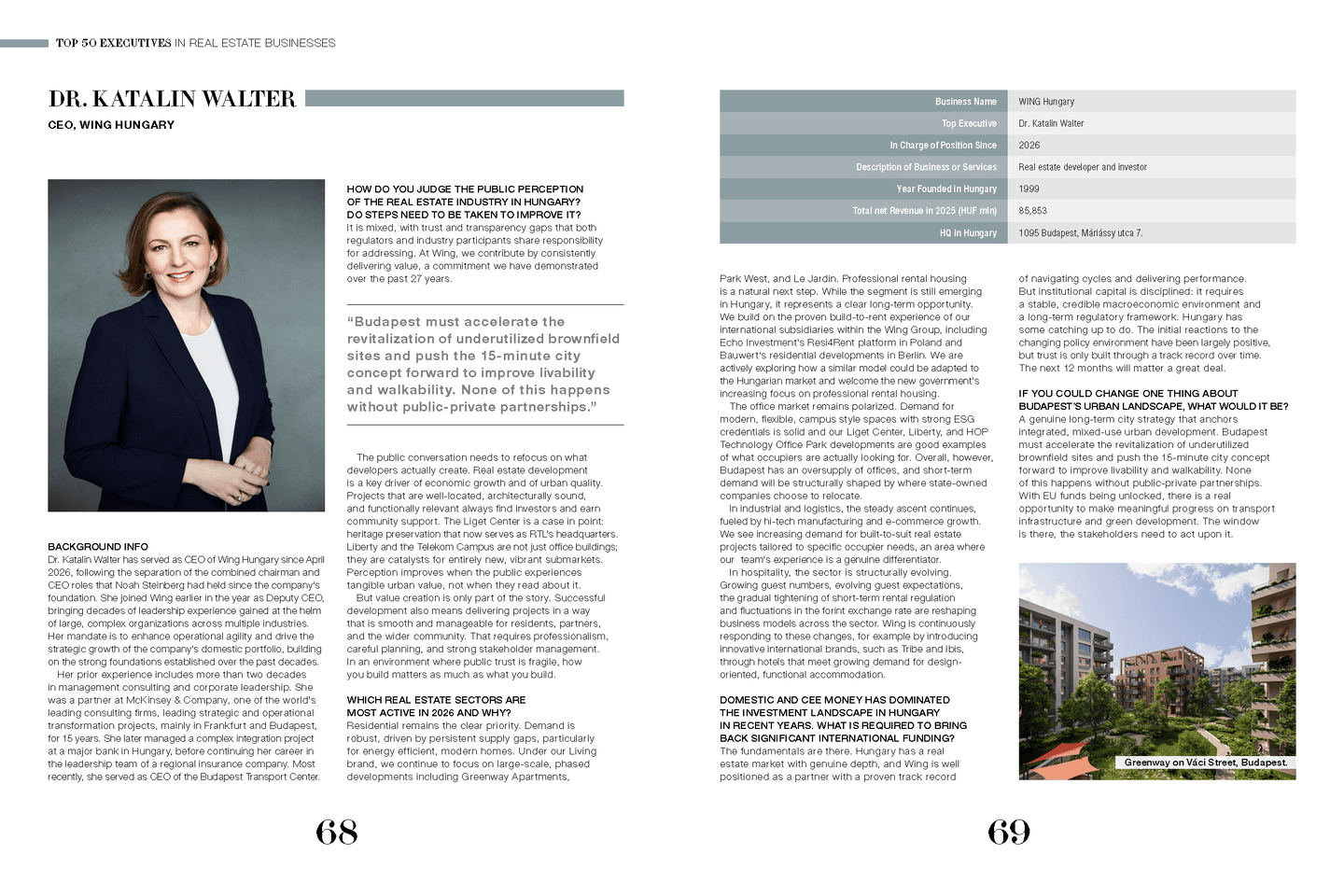
Dr. Katalin Walter - Top 50 Executives in Real Estate Businesses 2026
2026-07-06
Dr. Katalin Walter, CEO of WING Hungary, has been included in the 2026 Top 50 Real Estate Executives list in Hungary. The Top 50 Real Estate Executives is an annual special publication by the BBJ Budapest Business Journal that profiles the most influential real estate leaders working in the Hungarian economy.
BACKGROUND INFO
Dr. Katalin Walter has served as CEO of Wing Hungary since April 2026, following the separation of the combined chairman and CEO roles that Noah Steinberg had held since the company's foundation. She joined Wing earlier in the year as Deputy CEO bringing decades of leadership experience gained at the helm of large, complex organizations across multiple industries.
Her mandate is to enhance operational agility and drive the strategic growth of the company's domestic portfollo, building on the strong foundations established over the past decades.
Her prior experience includes more than two decades in management consulting and corporate leadership. She was a partner at McKinsey & Company, one of the world's leading consulting firms, leading strategic and operational transformation projects, mainly in Frankfurt and Budapest, for 15 years. She later managed a complex integration project at a major bank in Hungary, before continuing her career in the leadership team of a regional insurance company. Most recently, she served as CEO of the Budapest Transport Center.
How do you judge the public perception of the real estate industry in Hungary? Do steps need to be taken to improve it?
It is mixed, with trust and transparency gaps that both regulators and industry participants share responsibility for addressing. At Wing, we contribute by consistently delivering value, a commitment we have demonstrated over the past 27 years.
Budapest must accelerate the revitalization of underutilized brownfield sites and push the 15-minute city concept forward to improve livability and walkability. None of this happens without public-private partnerships.
The public conversation needs to refocus on what developers actually create. Real estate development is a key driver of economic growth and of urban quality.
Projects that are well-located, architecturally sound, and functionally relevant always find irvestors and earn community support. The Liget Center is a case in point: heritage preservation that now serves as RTL's headquarters.
Liberty and the Telekom Campus are not just office buildings: they are catalysts for entirely new, vibrant submarkets.
Perception improves when the public experiences tangible urban value, not when they read about it.
But value creation is only part of the story. Successful development also means delivering projects in a way that is smooth and manageable for residents, partners, and the wider community. That requires protessionalism. careful planning, and strong stakeholder management.
In an environment where public trust is fragile, how you build matters as much as what you build.
Which real estate sectors are most active in 2026 and why?
Residential remains the clear priority. Demand is robust, driven by persistent supply gaps, particularly for energy efficient, modern homes. Under our Living brand, we continue to focus on large-scale, phased developments including Greenway Apartments, Park West, and Le Jardin. Professional rental housing is a natural next step. While the segment is still emerging in Hungary, it represents a clear long-term opportunity.
We build on the proven build-to-rent experience of our international subsidiarles within the Wing Group, including Echo Investment's ResiRent platform in Poland and Bauwert's residential developments in Berlin. We are actively exploring how a similar model could be adapted to the Hungarian market and welcome the new goverrment's increasing focus on professional rental housing.
The office market remains polarized. Demand for modern, flexible, campus style spaces with strong ESG credentials is solid and our Liget Center, Liberty, and HOP Technology Office Park developments are good examples of what occupiers are actually looking for. Overall, however. Budapest has an oversupply of offices, and short-term demand will be structurally shaped by where state-owned companies choose to relocate.
In industrial and logistics, the steady ascent continues, fueled by hi-tech manufacturing and e-commerce growth.
We see increasing demand for built-to-suit real estate projects tailored to specific occupier needs, an area where our team's experience is a genuine differentiator.
In hospitality, the sector is structurally evolving.
Growing guest numbers, evolving guest expectations, the gradual tightening of short-term rental regulation and fluctuations in the forint exchange rate are reshaping business models across the sector. Wing is continuously responding to these changes, for example by introducing Innovative international brands, such as Tribe and Ibs, through hotels that meet growing demand for design-oriented, functional accommodation.
Domestic and CEE money has dominated the investment landscape in Hungary in recent years. What is required to bring back significant international funding?
The fundamentals are there. Hungary has a real estate market with genuine depth, and Wing is well positioned as a partner with a proven track record of navigating cycles and delivering performance.
But institutional capital is disciplined: it requires a stable, credible macroeconomic environment and a long-term regulatory framework. Hungary has some catching up to do. The initial reactions to the changing policy environment have been largely positive. but trust is only built through a track record over time.
The next 12 months will matter a great deal.
If you could change one thing about Budapest’s urban landscape, what would it be?
A genuine long-term city strategy that anchors integrated, mixed-use urban development. Budapest must accelerate the revitalization of under utilized brownfield sites and push the 15-minute city concept forward to improve livability and walkability. None of this happens without public-private partnerships.
With EU funds being unlocked, there is a real opportunity to make meaningful progress on transport infrastructure and green development. The window Is there, the stakeholders need to act upon it.
To buy the magazine, click on the link below: